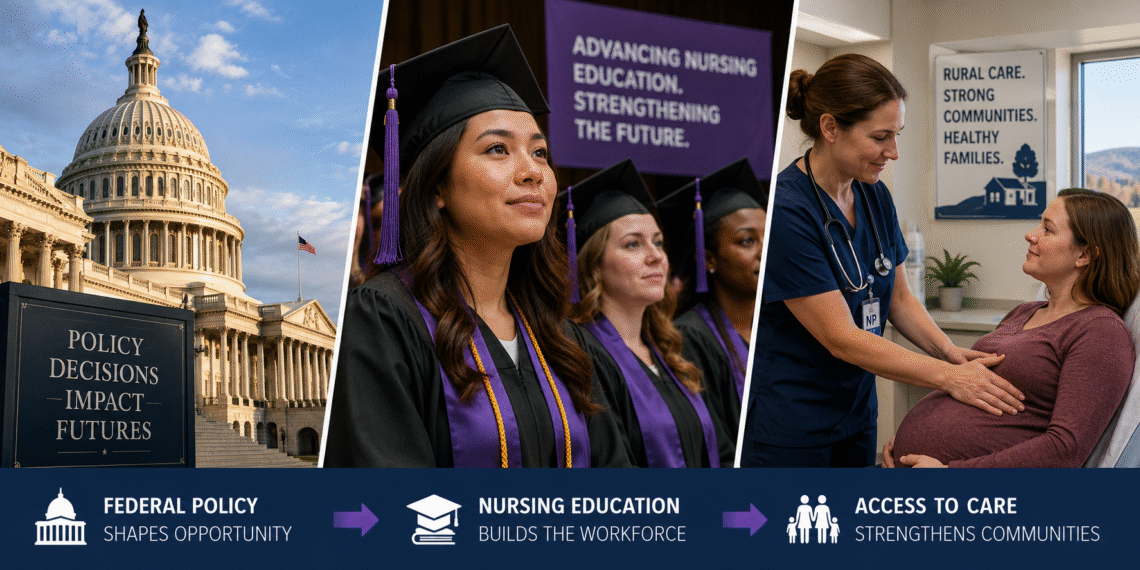
National Nursing Organizations Sue Department of Education Over Graduate Loan Restrictions for Advanced Nursing Degrees
On May 29, 2026, ten national nursing organizations took the unusual step of jointly filing a lawsuit against the U.S. Department of Education. Their claim is straightforward: the Department’s new interpretation of federal student loan regulations excludes many advanced nursing degree programs from the higher borrowing limits available to other professional degree students.
The organizations involved represent a broad cross-section of nursing, including the American Nurses Association (ANA), the American College of Nurse Midwives (ACNM), the American Association of Nurse Anesthesiology (AANA), the National Association of Clinical Nurse Specialists (NACNS), the National Association of Nurse Practitioners in Women’s Health (NPWH), and several others. Together, they argue that the rule creates unnecessary barriers to graduate nursing education at a time when the nation is struggling with significant healthcare workforce shortages.
Why This Matters
At first glance, federal student loan classifications may seem like an obscure regulatory issue. In reality, they have direct implications for the healthcare workforce.
Advanced nursing roles—including nurse practitioners, nurse-midwives, clinical nurse specialists, nurse anesthetists, nurse educators, and nursing leaders—require extensive post-baccalaureate education. These programs are often lengthy, clinically intensive, and expensive. Many students rely on federal loans to complete their education.
If graduate nursing programs are excluded from the federal government’s definition of “professional degree” programs, students may face lower borrowing limits despite pursuing careers that require advanced preparation and serve critical healthcare needs.
The nursing organizations argue that this policy does not reflect the realities of contemporary healthcare. Advanced practice registered nurses (APRNs) diagnose illnesses, prescribe medications, manage chronic diseases, provide primary care, attend births, deliver anesthesia, and fill essential roles in hospitals, clinics, and community settings throughout the country.
The Rural Health Connection
The impact may be particularly significant in rural and underserved communities.
Many rural areas already face persistent shortages of physicians, obstetric providers, primary care clinicians, behavioral health professionals, and specialty services. Advanced practice nurses frequently serve as the backbone of healthcare delivery in these regions.
Certified Nurse-Midwives provide maternity care in communities where obstetrical services have become increasingly difficult to sustain. Nurse practitioners often serve as primary care providers in areas with limited physician availability. Certified Registered Nurse Anesthetists are the primary anesthesia providers in many rural hospitals and critical access facilities.
Reducing access to educational financing could further constrain the pipeline of clinicians willing and able to practice in these settings.
Beyond Individual Students
The lawsuit raises a broader question: How does society value the nursing workforce?
Healthcare systems continue to face growing demands from an aging population, increasing chronic disease burden, and ongoing workforce shortages. At the same time, nurses are being asked to assume more complex clinical, leadership, educational, and systems-improvement responsibilities.
Policies that make advanced nursing education more difficult to obtain may have consequences that extend far beyond individual students. They may affect healthcare access, workforce stability, and the ability of communities to recruit and retain highly qualified clinicians.
What Happens Next?
The lawsuit seeks judicial review of the Department of Education’s rule and asks the court to recognize that post-baccalaureate nursing degree programs meet the statutory requirements for professional degree designation.
The outcome could have significant implications for future nursing students, graduate nursing programs, and healthcare workforce development nationwide.
While the legal arguments will ultimately be decided in court, the underlying issue is clear: access to advanced nursing education is not merely an educational concern. It is a healthcare access issue.
At a time when many communities struggle to recruit and retain healthcare professionals, policies affecting the nursing education pipeline deserve careful scrutiny. The question is not simply how students finance their education. It is whether the nation can afford to create additional barriers to preparing the advanced nursing workforce that patients increasingly depend upon.

Deborah Acker
Deborah Acker, JD, DNP, MSN, CNM, FACNM | Healthcare Systems & Workforce Innovation | Education | Clinical, Legal & Academic Integration | Rural & Perinatal Care


You May Also Like

Profession, Professional, & Professionalism – Post #2 – Policy Implications

Professional Nurses as Policy Leaders – Post #3