
Congress Must Recognize Nursing as a Profession
Congress Is Being Asked To Reverse A Federal Policy Change – Before It Reshapes Graduate Nursing Education
A new bill introduced in Congress — the Nursing is a Professional Degree Act (H.R. 8691/S. 4568) — attempts to reverse a recent federal policy decision that excluded post-baccalaureate nursing education from the federal definition of a “professional degree” for student loan purposes.
If you believe nursing education and healthcare workforce stability matter, now is the time to act.
What You Can Do Right Now
- Contact your U.S. Representative and Senators and ask them to support the Nursing is a Professional Degree Act
- Explain how graduate nursing education affects healthcare access in your community
- Share examples involving rural care, maternity care access, faculty shortages, or workforce recruitment
- Encourage nursing schools, hospitals, and professional organizations to speak publicly in support of the bill
- Follow the bill through committee review and upcoming congressional action
The Department of Education loan changes are currently scheduled to take effect July 1, 2026. If Congress does not act, the consequences will extend far beyond student loans.
This is not simply a funding issue.
It is a healthcare workforce issue.
The legislation was introduced with bipartisan support in both the House and Senate. The lead House sponsor, Representative Jennifer Kiggans of Virginia, is a former Navy nurse practitioner, alongside lawmakers with healthcare and military backgrounds and representatives from rural states heavily dependent on advanced practice nurses. Major nursing organizations, universities, and healthcare leaders quickly rallied behind the bill after the Department of Education excluded nursing from the federal definition of a professional degree.
The momentum reflects growing concern that policies affecting graduate nursing education will ultimately affect healthcare access itself — particularly in rural and underserved communities.
On the surface, some may dismiss this as a technical education funding dispute. It is not.
It is a revealing moment for nursing, healthcare policy, workforce planning, and the future of patient care in the United States.
For decades, nursing has carried increasing responsibility within the healthcare system. Nurses manage increasingly complex patients, coordinate fragmented systems, provide primary and specialty care, lead quality initiatives, educate future clinicians, and sustain healthcare access in rural and underserved communities. Advanced practice nurses now fill essential gaps in primary care, maternal health, behavioral health, and chronic disease management.
Yet despite this reality, nursing was excluded from the federal category of “professional degree” programs that qualify for higher graduate borrowing limits under recent Department of Education policy changes tied to new federal student loan rules.
Medicine, dentistry, law, pharmacy, and several other professions remained on the list.
Nursing did not.
Supporters of the policy insist this is merely an administrative definition related to loan caps and not a statement about the legitimacy of nursing as a profession. Technically, that may be true.
But symbols matter.
Definitions matter.
And policy choices matter.
Especially in a healthcare system already struggling with workforce shortages, rural hospital instability, burnout, faculty shortages, and declining access to maternity and primary care.
The Real Issue Is Larger Than Student Loans
The deeper issue is not simply whether graduate nursing students can borrow more money.

The deeper issue is whether national policy reflects a modern understanding of what nursing actually is.
For generations, nursing occupied an uneasy space between vocation, technical labor, public service, and profession. Historically, nursing education was often hospital-based, subordinate to medicine, and shaped by expectations of sacrifice rather than institutional authority.
Over time, nursing evolved.
The profession developed university education pathways, graduate specialization, licensure systems, evidence-based practice standards, doctoral education, advanced clinical roles, independent scholarship, and leadership in healthcare systems.
At the same time, healthcare itself changed. Hospitals became more technologically complex. Rural healthcare systems became fragile. The population aged. Chronic disease increased. Maternal care deserts expanded. Physician shortages deepened.
In many parts of the country — particularly rural America — advanced practice nurses are no longer supplemental providers. They are foundational infrastructure.
This is especially true in maternity care.
In communities where obstetric units close, where physician recruitment is difficult, and where hospitals struggle to maintain services, nurses and nurse-midwives often become the professionals holding the remaining system together.
That reality deserves policy recognition.
Professional Formation Matters
There is also a cultural issue embedded in this debate.
A profession is not defined solely by degrees, prestige, or income. Responsibility, standards, formation, accountability, ethics, and social trust define it.
Nursing has historically been one of the most trusted professions in the United States. That trust was not earned through branding campaigns or social media visibility. It was earned through responsibility carried quietly over generations.
But professions can weaken when they lose clarity about their identity.
Nursing today faces several simultaneous pressures:
- Increasing educational costs
- Faculty shortages
- Workforce instability
- Expanding clinical complexity
- Fragmentation within nursing roles and educational pathways
- Tension between professional identity and corporate healthcare structures
- Growing distance between frontline realities and policy decisions
The current debate should not become merely another partisan argument or social media slogan.
It should instead force a serious national conversation:
What kind of nursing workforce does the United States actually want to build?
A transactional labor force?
Or a stable profession capable of sustaining healthcare systems over generations?
Rural and Underserved Communities Will Feel the Consequences First
Policy decisions made in Washington often appear abstract until they reach rural communities.
Reduced access to graduate nursing education affects more than individual career advancement. It affects:
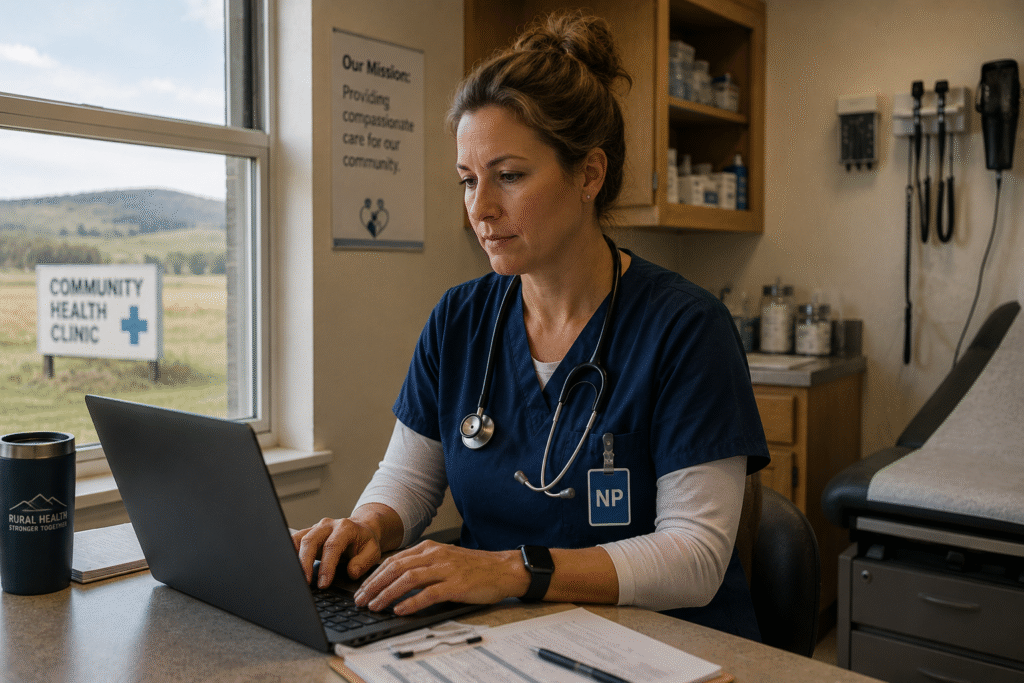
- Rural primary care access
- Maternity care availability
- Nurse faculty pipelines
- Public health capacity
- Small hospital sustainability
- Workforce recruitment and retention
- Emergency preparedness
The consequences rarely appear immediately.
They accumulate slowly.
A training pipeline narrows. A faculty vacancy goes unfilled. A rural clinic struggles to recruit. A maternity unit closes. An experienced nurse leaves the profession early.
Over time, the system becomes increasingly fragile.
Healthcare workforce policy should not be built around short-term accounting logic alone. It must account for long-term infrastructure stability.
Congress Has an Opportunity
The newly introduced legislation offers Congress an opportunity to correct course.
More importantly, it offers policymakers an opportunity to demonstrate whether they truly understand the modern healthcare workforce they depend upon.
The issue is not whether nursing needs symbolic validation.
Nursing has already proven its value.
The issue is whether federal policy will align with healthcare reality.
At a time when the nation faces persistent workforce shortages, rural healthcare instability, maternal health disparities, and increasing care complexity, narrowing pathways into advanced nursing education is difficult to justify.
The United States does not strengthen healthcare systems by making professional formation more difficult for the workforce that already sustains much of the system.
Nursing is not becoming a profession.
It already is one.
Why Advocacy Matters
Nursing has often carried an institutional culture of quiet endurance.
That tradition has strengths.
But healthcare policy is increasingly shaped by organizations and professions willing to articulate their value clearly and persistently.
If nursing education, rural healthcare access, maternity care systems, and workforce stability matter to the future of healthcare in the United States, then this is precisely the type of legislation that deserves organized support.
Congress should hear from the people who understand what happens when healthcare systems weaken from the ground level upward:
The clinicians. The educators. The rural hospitals. The patients. The communities.
Because once training pipelines shrink and healthcare infrastructure collapses, rebuilding it is far more difficult than preserving it in the first place.
Learn More / Take Action
- Use the National League for Nursing Advocacy Action Center to send a message to Congress supporting professional-degree designation for nursing programs.
- Read the Nursing is a Professional Degree Act (H.R. 8691/S. 4568)
- Contact your U.S. Representative and Senators
- Follow updates from the American Nurses Association (ANA) and American Association of Colleges of Nursing (AACN)
- Share this issue with nursing students, faculty members, healthcare leaders, and community organizations
- Encourage hospitals, universities, and professional organizations to publicly support the legislation
Healthcare systems are not sustained by policy language alone.
They are sustained by the people willing to protect the workforce before the damage becomes irreversible.

Deborah Acker
Deborah Acker, JD, DNP, MSN, CNM, FACNM | Healthcare Systems & Workforce Innovation | Education | Clinical, Legal & Academic Integration | Rural & Perinatal Care


You May Also Like

Interviews with Policy “Change Agents” – Post #5

Targeting Nursing and Undermining Health Equity – Post #1
